Write your book, your article, your text.You write, the AI improves it, another AI reviews it. And it saves itself.
- Houses whose models run off the same balance
- OpenAI
- Anthropic
- DeepSeek
- Qwen
- Mistral AI
- Meta
- Z.ai
- MiniMax
- Moonshot AI
- ByteDance
- Tencent
- Perplexity
- NVIDIA
- Xiaomi
- Baidu
- Meituan
20 free credits. No card, and they never expire.
After that, plans from $10 a month, or top-ups from $5, paid once.
You write a paragraph, or ask the machine for it. You improve it, carry on with the next one, and the text grows. Switch AI whenever you like — 301 models, one balance — have another one review it, and what you have written saves as you write.
01Four ways to write with two heads
Writing is not asking. It is going back over what you wrote.
Nobody writes a chapter in one go, and an AI does not either: ask, read, fix, return. What changes here is that the second reading is not done by whoever wrote it. You put two models on the same paragraph — one drafts, another audits — and the document stays; what changes is who touches it. No copying between windows, and no four subscriptions.
Start with one, fix it with another, and keep whichever reads better.
Compare 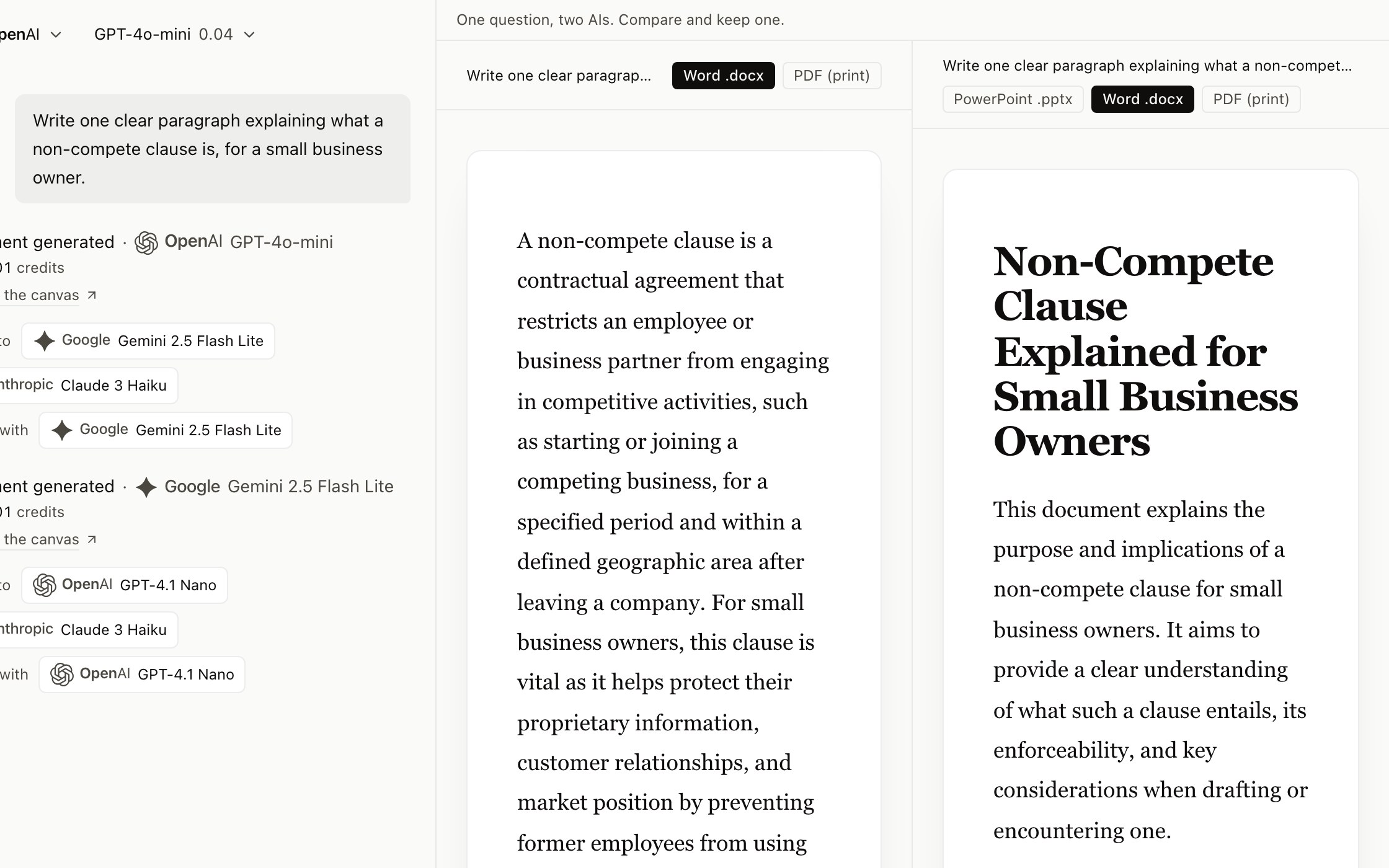
One paragraph, two versions, side by side.
Both models write the same thing at once and you keep the version that reads better. That is two turns and both are charged: it is exactly what you are buying, two ways of saying it instead of one. The button shows you the double price before you press it.
Comparing for real takes two houses. With one you can only ask twice.
Debate 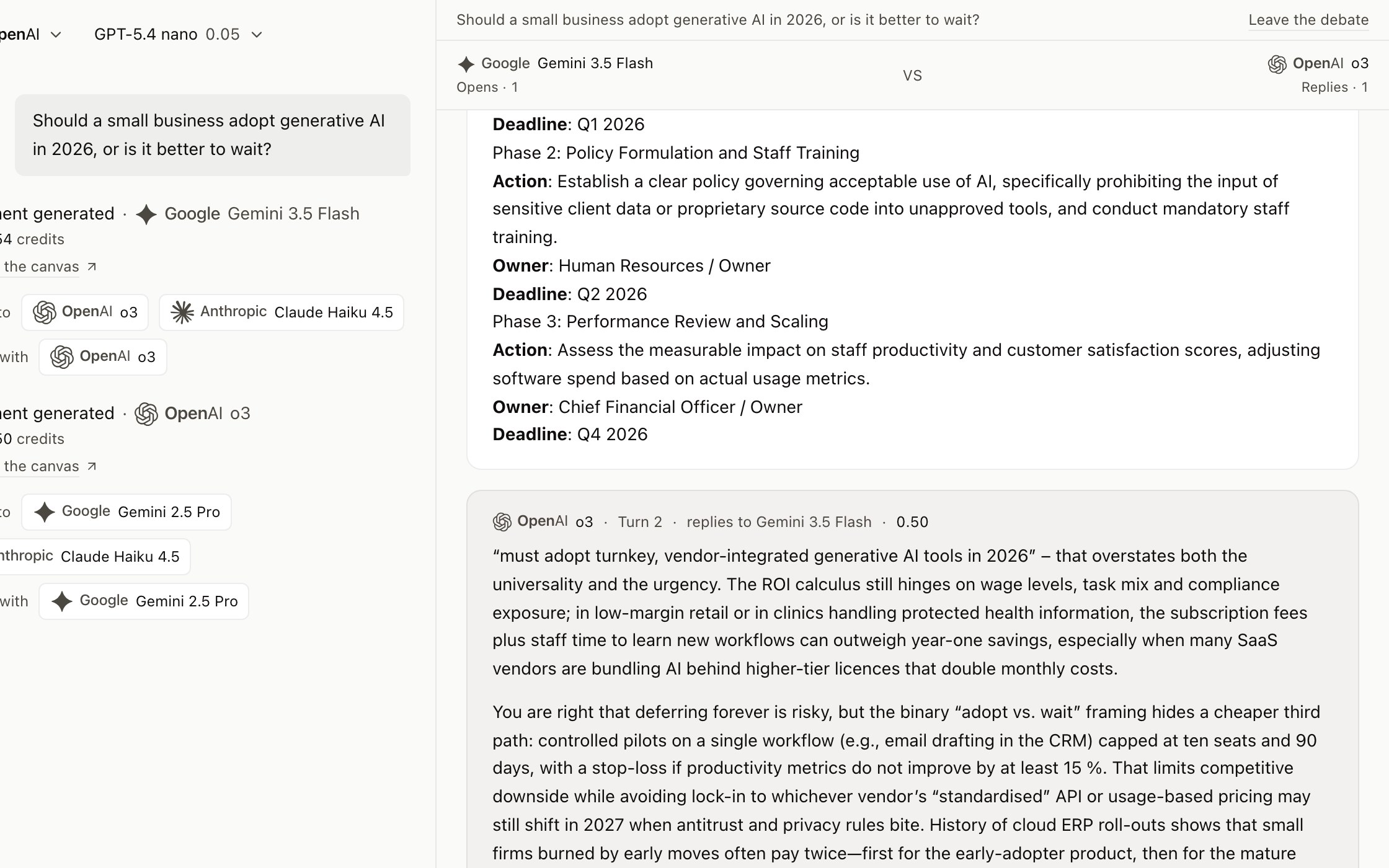
For when you must decide before you write.
For the chapter that rests on a claim you have not settled. Pick two models and put the question: one opens, the other reads it and answers, and you push the debate one turn at a time with its price on the button. At the end you ask for the conclusion, and that is the page you carry into the chapter.
You cannot fake this with a single model: it would be answering itself.
Review 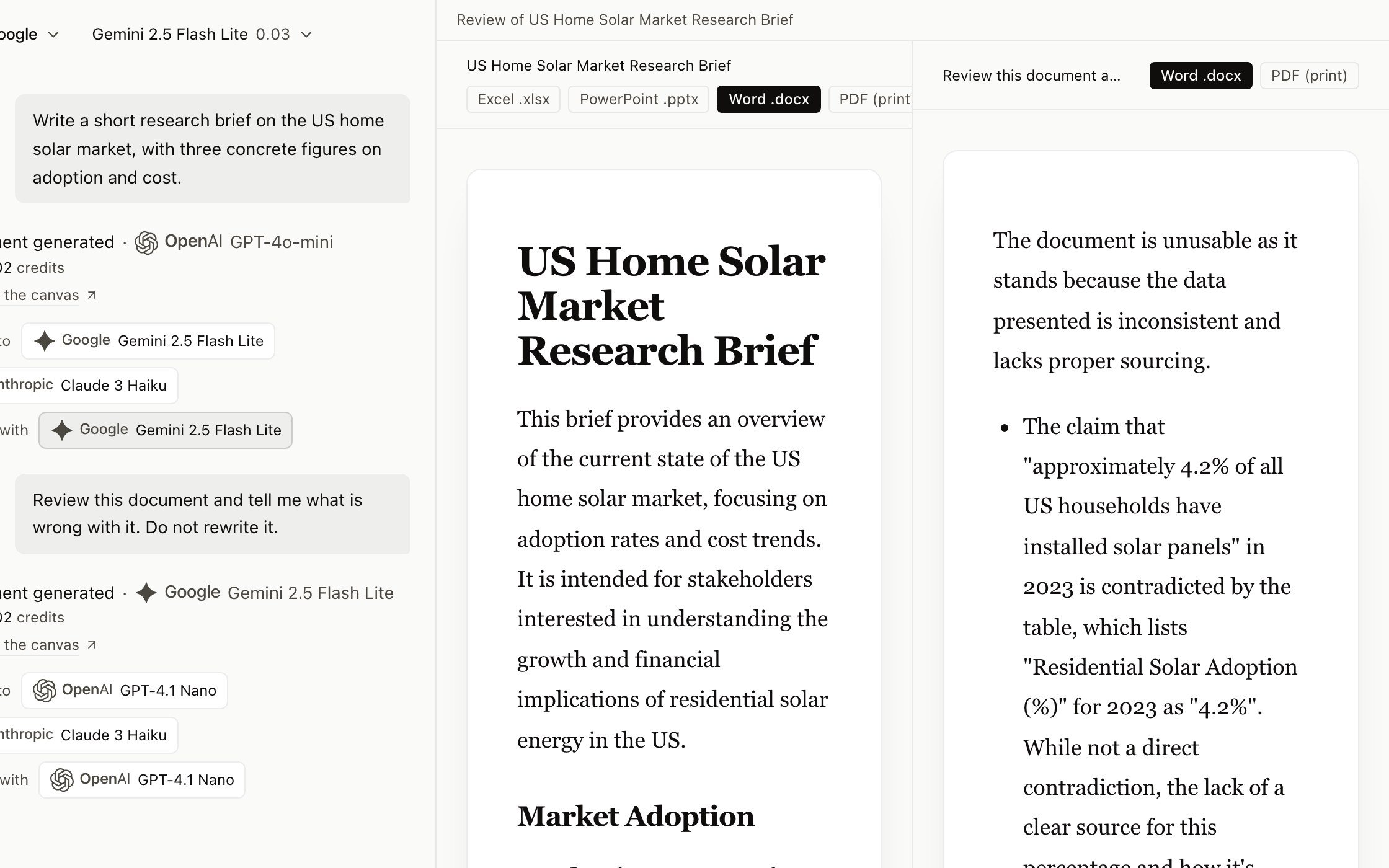
Let someone else read the chapter first.
You hand a second model what you have just written — yours or its — and ask it to audit: what is weak, what is missing, what does not hold. The audit opens its own document beside yours; your chapter is not touched.
A model reviewing its own text repeats its own blind spots.
Switch 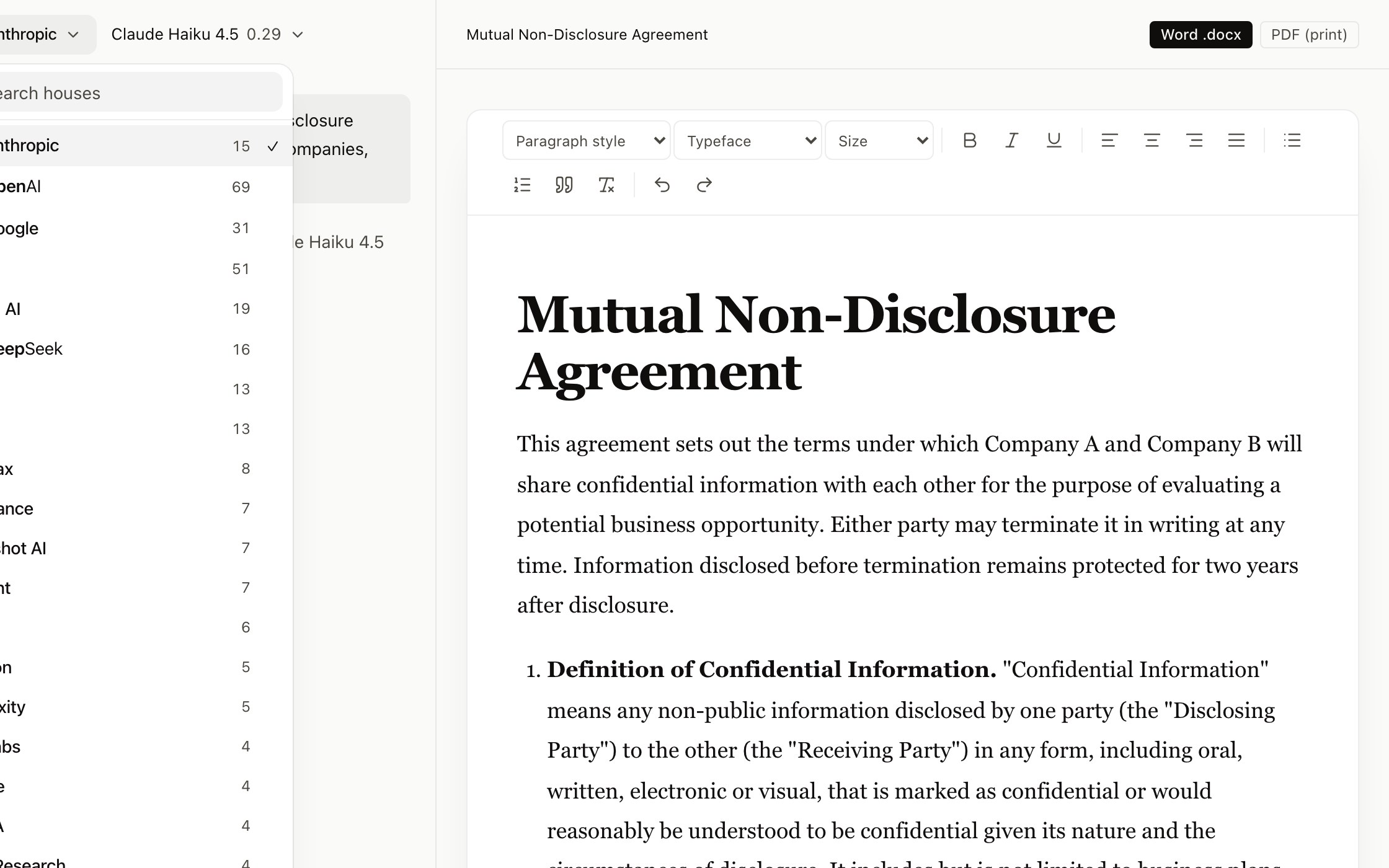
Change model mid-sentence, or chapter by chapter.
The text stays; the model changes turn by turn. Draft with a cheap one, hand the hard paragraph to a better one, and the chapter ends up signed by the houses that wrote it.
In a single-house product this does not exist: there is no other house to hand it to.
02Where the work lands
It comes out as the file you hand in, not as text to copy out.
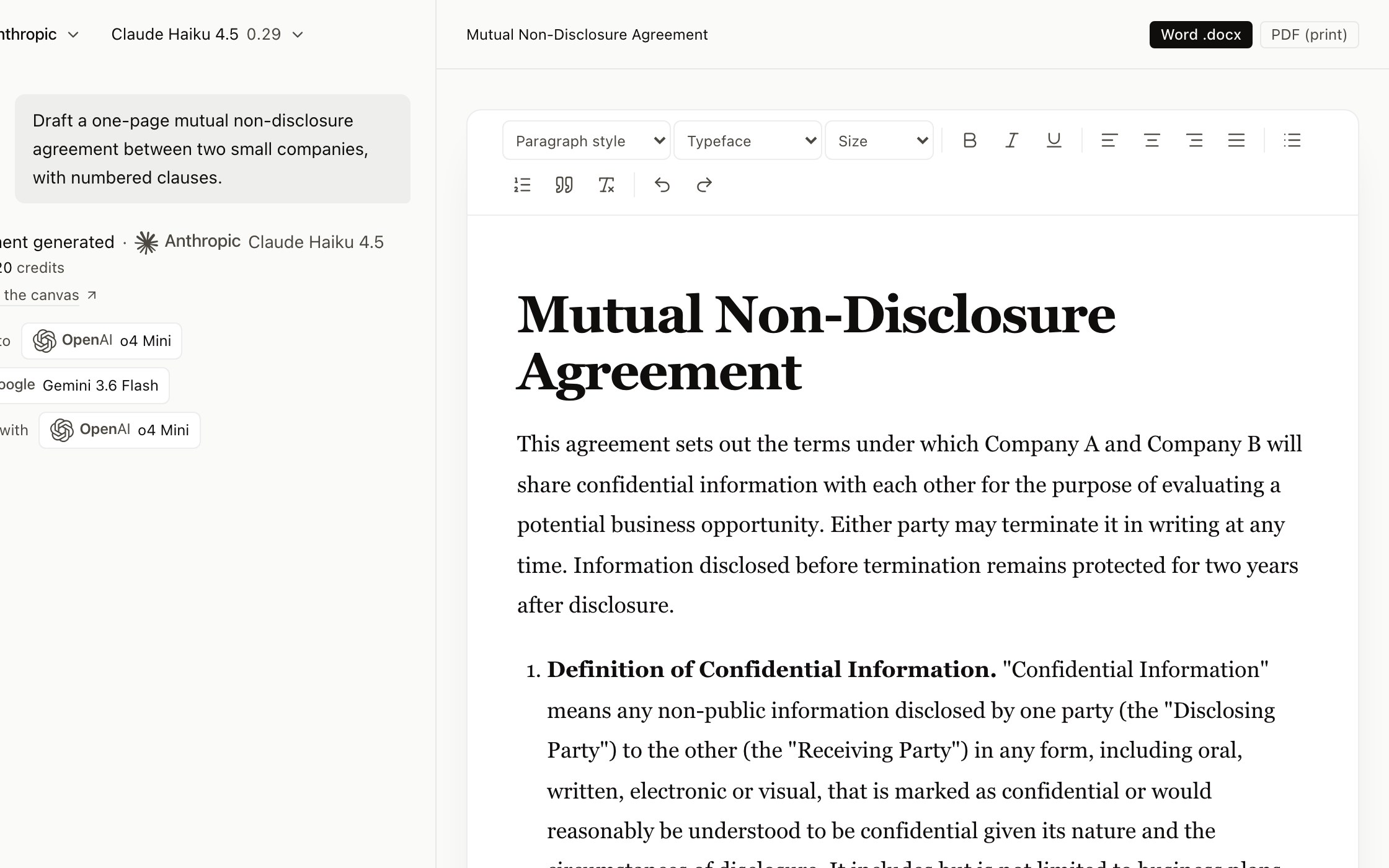
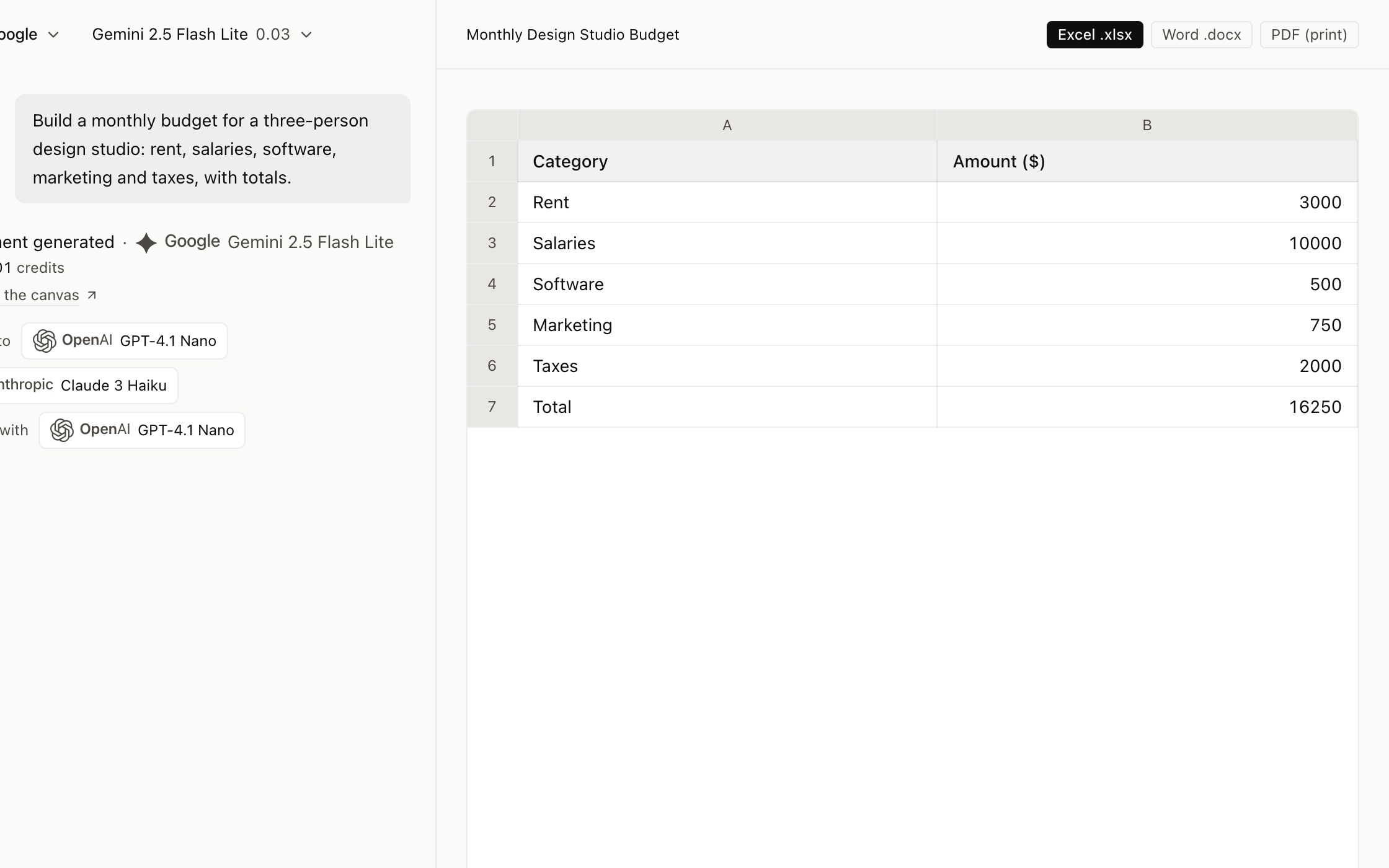
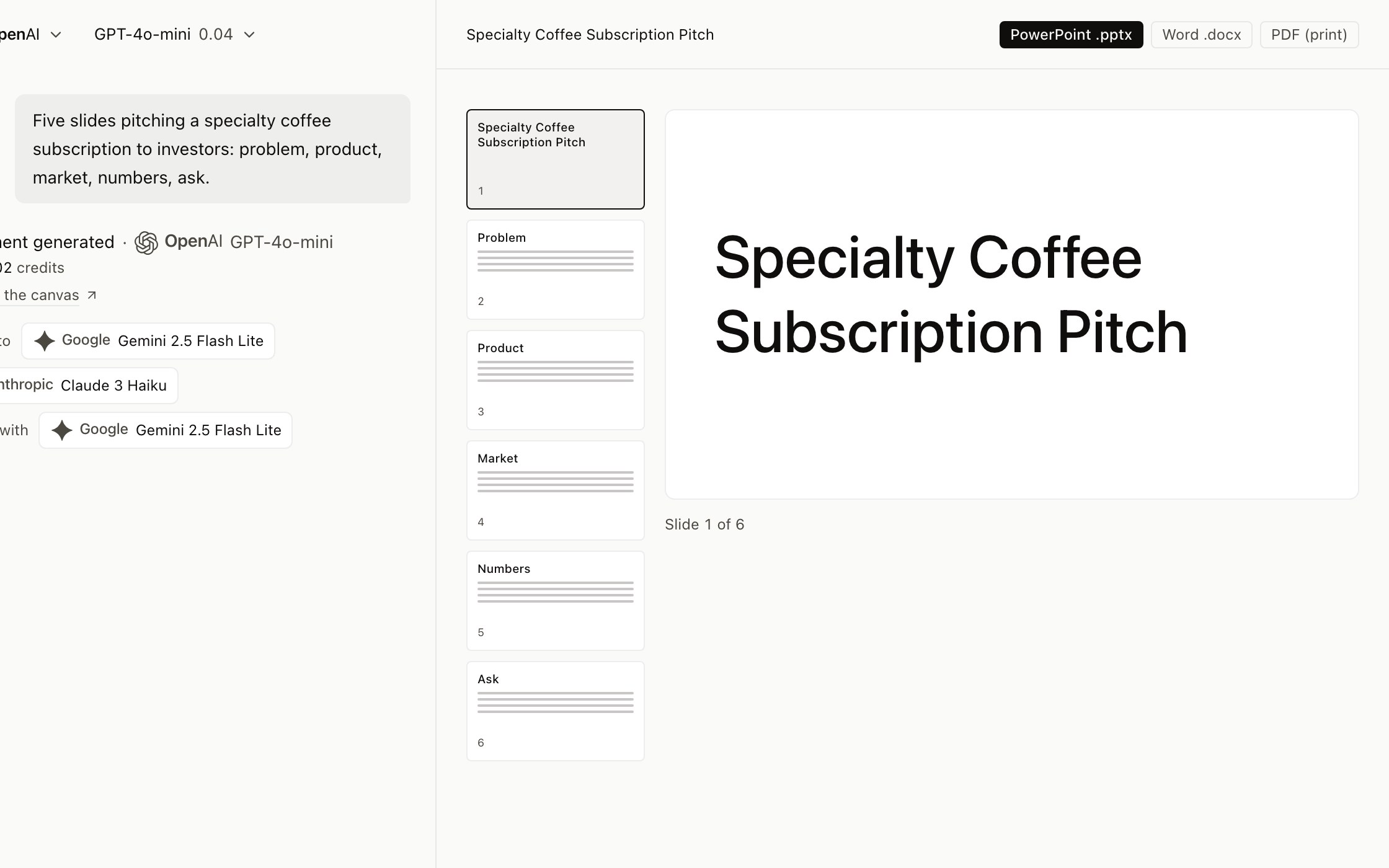
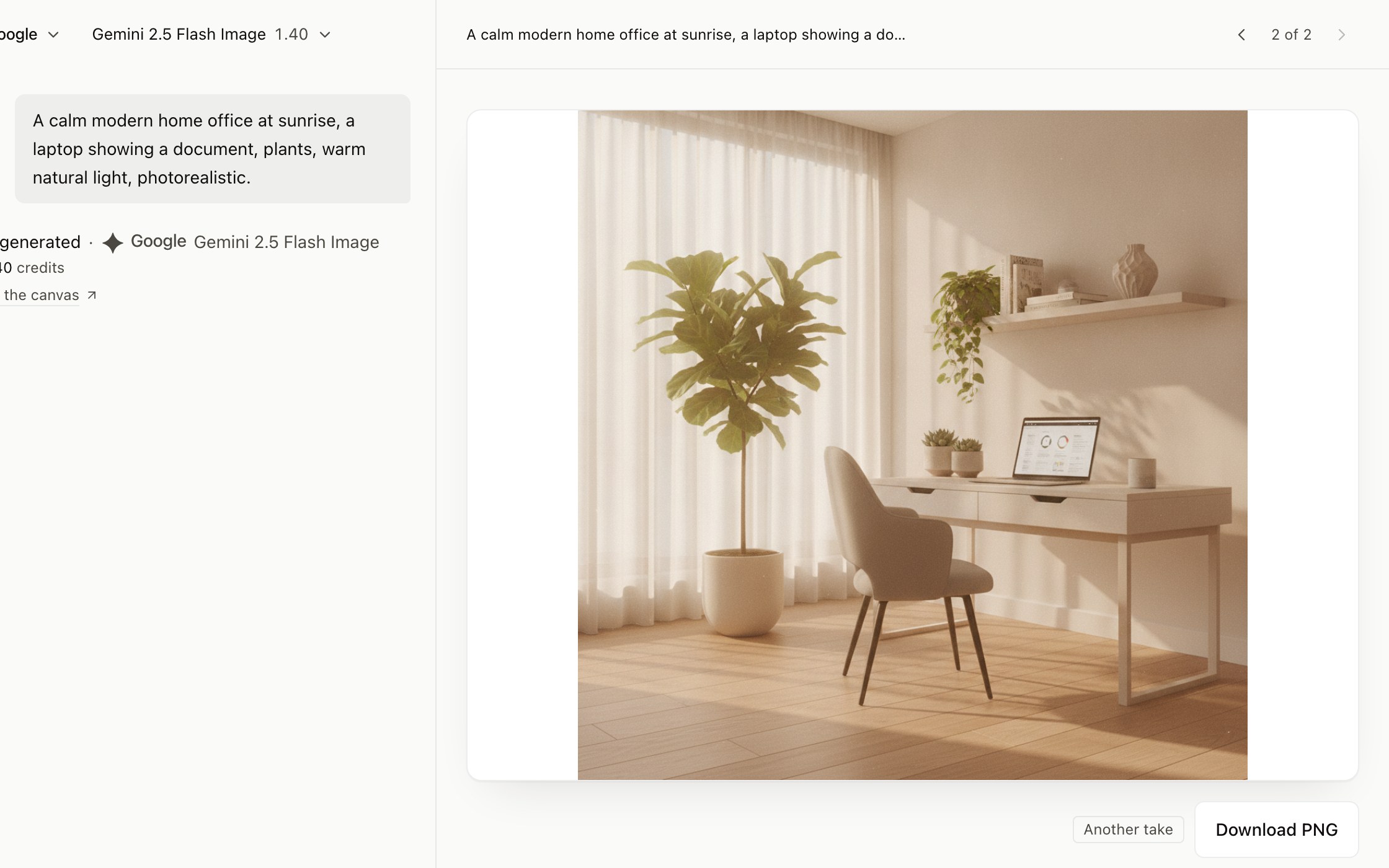
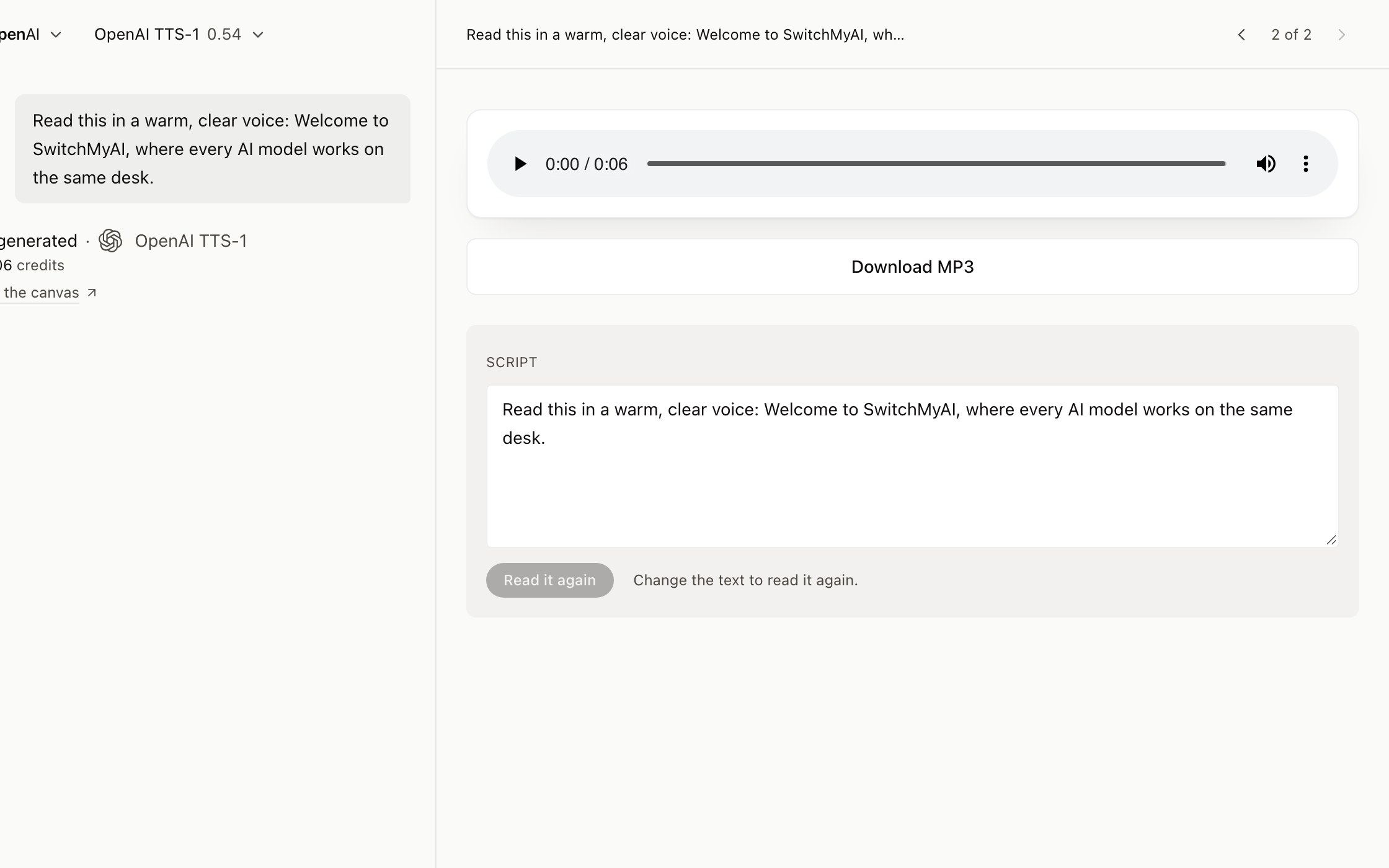
The panel becomes whatever you just made. Text opens in a word processor built into the page — headings, bold, lists, the ordinary furniture — so you rewrite a line, cut a paragraph, hand one section to a different model and keep whichever version reads better. Images open in a gallery you can look through and download from. Audio opens in a player. Nothing is copied out and reformatted somewhere else, because there is no somewhere else. And it leaves as .docx, .xlsx, .pptx, .pdf, .png or .mp3 — the formats a student hands in, a lawyer files, an accountant opens and a creator publishes.
- Word .docx
- The report you keep editing where you always do.
- Excel .xlsx
- The sheet with its columns, ready to add up.
- PowerPoint .pptx
- The slides, with their speaker notes.
- PDF .pdf
- What you send when nothing moves any more.
- Audio .mp3
- The narration, in the voice you pick.
- Image .png
- The illustration, in the frame you ask for.
03The engine room
Your text, open. 301 engines underneath.
Draft the chapter on the cheapest model in the catalogue, move to the best one for the paragraph that actually matters, and have a third audit it when you are done. You are not switching tabs, apps or accounts: the document stays open on the screen and only the engine underneath it changes. Each chapter can have its own.
The catalogue moves. Models get retired, new ones land, and the credit price of a turn follows whatever the provider charges for it. What is on this page is the line-up today, not a permanent one.
Second opinion
One writes. A different AI checks it.
Hand what the first house wrote to another one and ask it to audit. It catches what the author cannot see — a claim with no source, a number that does not add up — and on a light model it costs less than a cent.From chat to file
It writes into a document, not into a chat bubble.
The answer builds up in a real editor on the right of the screen, and you keep working on it there. When it reads right, it leaves as Word, Excel, PowerPoint, PDF or an audio file — already formatted.Pay per turn
The month you do not write, you do not pay.
Every turn costs what it costs and you see it on the button as you write. A chapter on a light model is pennies; the paragraph that matters, on the best in the catalogue, costs more and that is your call. And any payment — a plan or a top-up — reaches the frontier models too.What 100 credits buy
- Gemini 3.8 FlashGoogle
- 476turns
- Grok 4.6xAI
- 243turns
- Claude Opus 5Anthropic
- 71turns
- GPT-6 AstraOpenAI
- 35turns
A turn is one question and its whole answer. What it costs depends on the model you asked: a fraction of a credit for the light ones, a few for the best.
The same request, on different engines. Move the name and watch what changes: not the work, but how many times a hundred credits let you ask for it.
909turns per hundred credits
0.11 credits a turn · Qwen
Turns one hundred credits buy. The ruler steps by tens — 1, 10, 100, 1,000 — because thirty-five turns and 10,000 do not sit on the same straight line at any width a screen has.
04How you buy it
Writing it, picturing it, narrating it: three subscriptions. Or one balance.
This is not about quality. The houses on the left are the same ones we serve, and we serve them gladly. What is being compared is what a long text costs to get out today: write it in one, make the cover in another, narrate it in a third, three monthly charges running whether you open them or not, and none of the three aware the other two exist.
The usual way
One subscription for every kind of thing you make.
$35
a month, whether you use them or not.
- ChatGPT PlusText$20 a month
- Midjourney BasicImage$10 a month
- ElevenLabs StarterAudio$5 a month
- They run all twelve months, including the month you make no images at all.
- Three accounts, three cards on file, and three places to cancel.
- The draft lives in one app, the cover in another, and you move them by hand.
- Each subscription brings its own usage limits, and none carry over to the next.
List prices checked in September 2026. Each house sets its own and can change it without telling us, which is why they are dated.
How you buy it here
One account, one balance, one plan — or none at all.
$20
a month, and it is 220 credits for text, image and voice on every model. Cancel in one click.
Or with no plan at all: top-ups from $5, paid once.
- One plan covers the three uses on the left, on the same balance.
- The month you don’t want it, cancel in one click; and if you prefer, top-ups that never expire.
- Text, image and voice land in the same workspace, with nothing pasted anywhere.
- Credits work on any model in the catalogue, the frontier ones included.
The plan is cancelled from the billing portal inside your own account. And nobody makes you take it: the one-off top-ups are right there.
No other companies’ logos, and nothing struck through: ChatGPT, Claude and Gemini are not the problem. They come from the houses whose product we serve, and all three are in this page’s catalogue. What is surplus is having to subscribe three times to use them.
05Plainly
Every number on this page comes from the same table that charges you, and you can check any of them. Prices, model counts, what a credit buys — all of it is arithmetic you can redo.
Your document is yours
What you write here belongs to you. The text of a turn goes to the provider you picked for that turn and to no other; change the model and the next turn goes to the next provider. Nothing is sent to a house you did not choose.
What we won’t promise you
Every provider sets its own terms for text sent through its API, and ours are not signed. So we are not going to write you a sentence about training or retention that no contract backs. The terms, provider by provider, will be published on this site before launch.
Only prices
The one kind of number on this page. Each one comes from the published rate of the provider that serves the model, through the same formula for all of them. No model is marked up more than the rest.
06The price
Subscribe and the credits arrive every month. Or pay once and be done.
A turn is one question and the answer to it. What it costs depends on the model you asked and on nothing else — not on the plan, not on the month, not on how much you have already used. And the price is shown before the turn is sent, not after it is billed.
Free
20 credits
The moment you verify your email. No card, and nothing else asked of you. One per account, and these don’t expire either.
Every month, on its own
From $10 a month: 110 credits that land on their own, and one click to cancel from your own account.
| Every month | Credits | Paid once gives | Per credit |
|---|---|---|---|
| $10per month | 110+10% bonus | 100+10 | $0.091 |
| $20per month | 220+10% bonus | 200+20 | $0.091 |
| $50per month | 550+10% bonus | 500+50 | $0.091 |
- More credits for the same money, on every plan: the table shows exactly how many more than paying once.
- They land on their own at the start of each month, and you cancel in one click from your own account.
- Every model in the catalogue, the frontier ones included, from the first month.
- A month's credits are spent that month, plus three days of margin.
Rather pay once?
Buy credit when you need it. It never expires, nothing renews and there is nothing to cancel.
| Paid once | Credits | Per credit | You save |
|---|---|---|---|
| $5 | 50 | $0.100 | This is the top-up the others are measured against. |
| $10 | 100 | $0.100 | Same price per credit as the smallest top-up. |
| $20 | 200 | $0.100 | Same price per credit as the smallest top-up. |
| $50 | 500 | $0.100 | Same price per credit as the smallest top-up. |
| $100 | 1,000 | $0.100 | Same price per credit as the smallest top-up. |
| $200Best value | 2,100+5% bonus | $0.095 | 5% |
| $500 | 5,500+10% bonus | $0.091 | 9% |
| $1,000 | 11,500+15% bonus | $0.087 | 13% |
- What you buy never expires, as long as your account is open.
- Nothing renews: nothing to cancel, and no month paid for and never opened.
- From $200 up, a top-up adds bonus credits, and the bonus grows with the amount.
| Model | Credits a turn | Turns per 100 credits |
|---|---|---|
| Nova Micro 1.0Amazon | 0.01 | 10,000 |
| Gemma 4 31BGoogle | 0.03 | 3,333 |
| Gemini 3.1 Flash-LiteGoogle | 0.08 | 1,250 |
| Qwen3 30B A3B Thinking 2507Qwen | 0.11 | 909 |
| DeepSeek V4 ProDeepSeek | 0.21 | 476 |
| Gemini 2.5 ProGoogle | 0.49 | 204 |
| GPT-6 Astra ProOpenAI | 2.79 | 35 |
The last row is one of the most expensive frontier models in the catalogue, and you pay it only on the turns where you choose it. The first row is the same hundred credits spent on the lightest model in the catalogue: 10,000 turns. Most work sits between the two, and you are the one who decides where.
Seven of the 301 models in the catalogue, drawn from the same table that charges. Every model carries its own number, worked out the same way, and you see it in the picker before you send.
The figures above are a reference turn — two thousand tokens in, eight hundred out — so that seven models can be compared on one measurement. What you actually spend follows the length of the answer: a long document costs more than a short question.
Rates published 17 September 2026.
Start with a blank page.
Free credits the moment you verify your email, no card. After that, a monthly plan that lands credits on its own, or top-ups paid once. Sign in with Google or with a code sent to your email. Plans from $10 a month, or top-ups from $5, paid once.
Cancel anytime · 20 free credits when you verify your email